
How to Organise Your Important Documents, and Actually Find Them When You Need Them
A Professional Organiser's guide to sorting, storing and managing your important documents, with a UK-specific category list and practical system.
Jo de Serrano OBE DUniv
6 min read

Last updated: July 2025
Key Takeaways
Most people are not disorganised; they simply never had a system. A system does not have to be complicated to work.
The categories you use need to make sense to you, not to some ideal version of you. Practical beats perfect every time.
There are documents you need to be able to lay your hands on in minutes. Know which ones those are and keep them separate from everything else.
Paper and digital are not an either/or. A sensible hybrid approach suits most people and most households.
The real problem is usually the backlog, not the ongoing maintenance. Once the backlog is cleared, keeping up is manageable.
I have a lot of clients who describe themselves as disorganised with paperwork. They are usually wrong. What they actually have is a backlog, sometimes years of it, and no system for incoming documents. Once those two things are sorted, most people are perfectly capable of keeping on top of it. The problem was never them; it was the absence of a structure.
This guide walks through how to build that structure: what categories to use, what you actually need to keep, how long to keep it, and how to make sure you can find things when you need them. Which, in my experience, is usually at nine o'clock on a Tuesday morning when something has gone wrong.
Start With the Right Information
Before you reorganise anything, you need to know what to keep and for how long. I have put together a detailed UK document retention guide that covers every common household document, from bank statements to birth certificates, P60s to pet insurance, with specific retention periods and the reasoning behind them. It also has sections for sole traders and limited company directors.
Download it below, then use the rest of this article to build the system around it.
Free Download: How Long Should I Keep This?
Not sure what to keep and what to shred? The Order from Chaos Document Retention Guide covers every common household document, from bank statements to birth certificates, warranties to wills, with clear retention periods, UK-specific guidance, and sections for PAYE employees, sole traders, and limited company directors.
Before You Start: The Triage Principle
The single most useful thing you can do before you build any system is triage what you already have. That means going through the existing pile, or piles, and sorting everything into three groups: keep, shred, and action required.
"Keep" is for documents that need to go into your permanent system. "Shred" is for anything outdated, superseded, or irrelevant: old utility bills from five years ago, statements you have already checked, instruction manuals for appliances you no longer own. "Action required" is the small but important category of things that actually need something done: a form to fill in, a bill to query, a renewal to process.
Do not try to file as you go during triage. Sort first, file second. Trying to do both at once is how triage sessions turn into three-hour ordeals that end with everything back in a pile.
The Categories You Actually Need
There is no single right way to organise documents, but most households work well with some version of the following. Use the labels that make sense to you; the point is to create a system where you know, without thinking, where something lives.
Vital Records
These are the documents you cannot replace easily, or cannot replace at all. They belong somewhere secure, ideally a fireproof box or safe, and should be the first thing you know where to find in an emergency.
Birth, marriage, civil partnership and death certificates. Passports, and expired passports if you have them (useful for ID purposes). Adoption papers. National Insurance cards or numbers. Educational qualifications and professional certifications. Driving licence. Global Health Insurance Card (GHIC).
Legal Documents
Wills and any associated letters of wishes. Powers of attorney, both lasting power of attorney documents, if you have them (property and financial affairs; health and welfare). Any trust documents. Your most recent copy of any significant contracts, tenancy agreements, purchase deeds, and major service contracts.
If you have a will, make sure your executor knows where it is. That sounds obvious. You would be surprised how often the Executor is unaware.
Financial Documents
Tax returns and their supporting documents: retention periods vary depending on your employment status, and the download above has the specifics. Bank statements, pension statements, investment account statements. Property-related documents: deeds, Land Registry documents, mortgage paperwork.
If you are self-employed or run a limited company, keep your financial records separate from your personal documents. They have different retention requirements, and you will save yourself significant time at year-end.
Insurance Policies
Home buildings and contents. Car. Life. Health or income protection. Travel, if you have an annual policy. Keep the current policy document and the renewal letter together. When you renew, the old policy can generally be shredded, unless there is an open or recent claim.
Property and Vehicle
If you own your home: the title deeds (though most are now held digitally by the Land Registry), the original conveyancing documents, any planning permissions, building regulations certificates, and FENSA certificates for windows. If you rent: your tenancy agreement and any correspondence about deposits or repairs.
For vehicles: V5C logbook, MOT certificates (keep the last few), service history, and any outstanding finance documentation.
Medical
Vaccination records are especially relevant if you travel, have children, or work in healthcare. Any significant medical correspondence or test results you want to keep. NHS number written down somewhere accessible, not just memorised.
Household Warranties and Manuals
Keep together: all current appliance warranties with their purchase receipts attached, boiler service records, and any guarantees for building work or home improvements. When an appliance leaves the house, shred its documents. Most instruction manuals are available online now; you generally do not need the paper version unless the warranty or installation documentation might be relevant for a claim.
Paper, Digital, or Both?
The honest answer is: both, for most people. Originals of vital records should be kept as paper in a secure location. Everything else can reasonably be scanned and stored digitally, with the paper shredded once you have confirmed the scan is legible.
If you do go digital, a consistent folder structure matters: year, then category, then document name with the date in the filename. Back up to at least two places, a cloud service and an external drive kept somewhere other than your home. A fire that destroys your paper documents will also destroy a laptop stored next to them.
The Incoming Paperwork Problem
Most systems work well until they hit the daily reality of Post-it notes, receipts, and random bits of paper appearing from nowhere. The incoming problem is what causes backlogs to develop in the first place.
Deal with the post on the day it arrives if you can. Open it, make an immediate decision, bin, shred, action, file, and deal with it. A "to file" tray can work, but only if it gets emptied at least weekly. A "to file" tray that becomes a "might file someday" tray is just a pile with better branding.
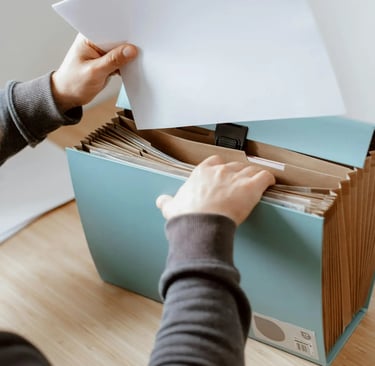
A concertina folder with pre-labelled sections is one of the simplest systems I have seen work consistently. It does not require a filing cabinet, it fits in a drawer or on a shelf, and it is quick to use because there are no decisions involved; you just put things in the right section.
When the Paperwork Has Got Away From You
If you are reading this because you have a significant backlog rather than a maintenance problem, be realistic about what a clear-out involves. A proper sort-through of several years of accumulated paperwork is a half-day job at minimum, often longer. It requires decisions, a shredder, and a certain amount of stamina.
Breaking it into sessions, one box or one category at a time, is usually more sustainable than trying to do it all at once. Start with the section that causes you the most anxiety: that is usually either financial documents or the miscellaneous pile that has been there the longest.
If you would rather have someone alongside you for this, paperwork and life admin is one of the specific services I offer. Some clients find the presence of another person, someone who asks the questions, keeps the pace, and provides a bit of external accountability, makes all the difference between a job that keeps getting deferred and a job that actually gets done.
Related Articles
→ The Secret to Staying Organised: A Professional's Guide to Maintaining Order After A Declutter
→ How to Declutter a Garage: A Professional's Blueprint to Success
Order from Chaos
Direct Approach. Bespoke Solutions.
© 2026. All rights reserved.








Based in Croydon, serving London, the Home Counties, and South East England, with virtual services available worldwide. See Areas I Cover
Blog
APDO Member / Enhanced DBS / Fully Insured / ICO Registered: ZB705394
Registered Address: 71-75 Shelton Street, WC2H 9JQ Company Number: 14974139
Order from Chaos is founded by Jo de Serrano OBE DUniv, APDO member, Enhanced DBS cleared, and fully insured. Late-diagnosed AuDHD with 25+ years of professional experience bringing structured, practical thinking to the chaos of everyday home life

