
Perimenopause and Clutter: Why Your Home Feels Out of Control (And What Helps)
Brain fog, decision fatigue, overwhelm, and perimenopause all affect your ability to manage your home. Here's why it happens and what genuinely helps. From an organiser who gets it.
Jo de Serrano OBE DUniv
5 min read
Last updated: May 2026
Key Takeaways
The cognitive symptoms of perimenopause, such as brain fog, decision fatigue, and difficulty concentrating, are well-documented and directly affect your ability to manage your home. This is not a motivation problem.
Clutter feels worse during perimenopause because the mental load of managing it is higher. The environment is not the cause; it amplifies what is already difficult.
Smaller, more frequent resets work better than infrequent big clear-outs when cognitive load is high. Ten minutes daily beats a paralysing weekend project.
Visible, low-friction systems are not a shortcut; they are the appropriate design response to how the brain is working during this period.
Getting support is not admitting defeat. It is a practical response to a real and temporary change in capacity.
You used to be organised, and you had systems that worked. You knew where things were, but now, somehow, you can't keep on top of anything. The kitchen surfaces are covered, the admin pile has grown a third pile next to it, there are oodles of tabs open in your browser, and the idea of tackling any of it feels impossible.
If you're perimenopausal or menopausal, this is not you failing. This is your hormones affecting your brain in ways that nobody warned you about, and in ways that we are only just starting to talk about.
What Perimenopause Does to Your Brain
Oestrogen and progesterone don't just regulate your cycle; they also play a significant role in cognitive function, memory, mood regulation, and executive function, i.e., the set of mental skills that allow you to plan, organise, prioritise, and make decisions. Source: NICE Guideline NG23: Menopause, Identification and Management (updated November 2024). Published by the National Institute for Health and Care Excellence.
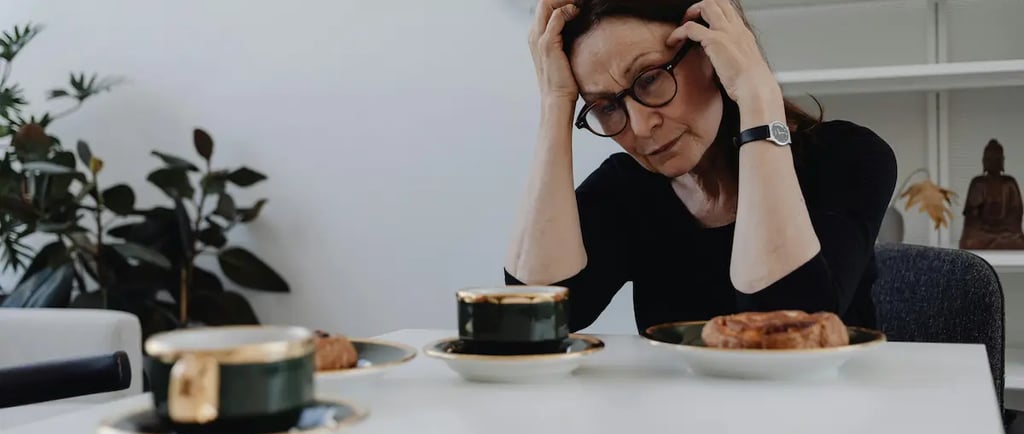
As those hormones fluctuate during perimenopause, so does your capacity for all of those things. On some days, you're fine, but on others, you stand in the kitchen unable to remember why you came in or which of the 17 things you need to do should happen first. The medical term is cognitive impairment, but most women call it brain fog, and it is debilitating. When this happened to me, I thought I had early-onset dementia, and I was really scared.
And brain fog makes the job of managing a home, which is an endless series of small decisions, tasks, and systems, genuinely much harder than it used to be, especially when you're part of the sandwich generation, looking after both your kids and your elderly parents at the same time.
Why Clutter Gets Worse During Perimenopause or Post Menopause
Decision Fatigue is Amplified
Decluttering is fundamentally a decision-making task. Keep it or let it go? Where does it live? Do I have one of these already? Will I need it in future? What category does it belong to? When your brain is already struggling with decision-making due to hormonal changes, adding the cognitive load of sorting through accumulated possessions can tip you into complete paralysis. The overwhelm means you can't even start to declutter, let alone finish.
Motivation and Mood Fluctuate
The Oestrogen roller coaster that happens during perimenopause can cause low mood, anxiety, and exhaustion that come and go unpredictably. You might plan a decluttering session on a Tuesday, feeling capable, and wake up on Tuesday unable to get off the sofa and lacking the mental and physical capacity to do anything. This isn't a lack of willpower or laziness; this is hormonal.
Sleep Deprivation Makes Everything Worse
Night sweats and sleep disruption are among the most common perimenopause symptoms. Chronic sleep deprivation significantly impairs executive function, meaning the ability to plan, organise, and make decisions deteriorates further. Running a household on poor sleep whilst managing brain fog and mood changes is an enormous ask.
The Shame Cycle
You can see that your home isn't the way you want it, and you remember being more on top of things; that gap between who you were and how things are now can feel deeply shameful, particularly if you've always prided yourself on being capable and organised. The shame makes it harder to seek help. The clutter builds. The shame deepens.
What Actually Helps
Work With Your Good Days
Rather than scheduling decluttering sessions in advance and then feeling like a failure when you can't do them, try working opportunistically. When you have a good day and have energy, clarity, and capacity, do a targeted 30-minute session. Don't try to do everything. Do one thing well.
Lower the Bar on What 'Done' Looks Like
Perfect is the enemy of good. The Pinterest kitchen with the matching containers and the hand-lettered labels is not the goal. The goal is a kitchen where you can function. If everything is in the right area, you know where to find things, where to put things back, and you can cook without stress, that is enough. Perfectionism is the enemy of progress when you're already stretched.
Create Low-Effort Systems
The best organising system is the one that requires the least mental energy to maintain. Open boxes rather than lidded ones, similar categories together rather than in different areas. Friction is the enemy, so the goal is to remove as much of it as possible.
Get Support for the Sessions That Feel Impossible
There is no award for doing this alone. A Professional Organiser eases the decision-making burden from you, which is often the part that's most depleting. You don't have to generate the energy to decide and to physically do; you just have to show up, and the Professional Organiser will facilitate progress.
Be Honest with Yourself About Capacity
You are not the same person you were five years ago, at least not right now. Perimenopause is a significant physiological event, and it has a real impact on your daily capacity. The home management expectations you hold yourself to may need to flex while your body adjusts. That is not giving up. That is being realistic. Enlist support to make life easier.
You Don't Have to Manage this Alone
I work with women across London and the Home Counties who are navigating exactly this scenario. Many of them describe feeling like they've 'lost themselves ', and these are capable, organised people who suddenly can't keep on top of their own homes. That experience is real, and it is not permanent.
Sessions are paced to your energy on the day. There's no judgement about how things got to where they are, and we focus on creating systems that work with your energy and capacity,
If this resonates, book a free discovery call. We'll talk through where you are and what would actually help. You can also find out more about how I can help during perimenopause.
Related Articles
You Might Also Find This Useful
→ Perimenopause and Clutter: Why Your Home Feels Out of Control (And What Helps)
→ What Is Decision Fatigue in Decluttering, and Why It Makes Starting So Hard
→ The Secret to Staying Organised After a Declutter
→ Why ADHD Brains Struggle with Decluttering, and What Actually Helps
Order from Chaos
Direct Approach. Bespoke Solutions.
© 2026. All rights reserved.








Based in Croydon, serving London, the Home Counties, and South East England, with virtual services available worldwide. See Areas I Cover
Blog
APDO Member / Enhanced DBS / Fully Insured / ICO Registered: ZB705394
Registered Address: 71-75 Shelton Street, WC2H 9JQ Company Number: 14974139
Order from Chaos is founded by Jo de Serrano OBE DUniv, APDO member, Enhanced DBS cleared, and fully insured. Late-diagnosed AuDHD with 25+ years of professional experience bringing structured, practical thinking to the chaos of everyday home life

