
The Art of Letting Go: A Professional Organiser's Guide to Decluttering Sentimental Items
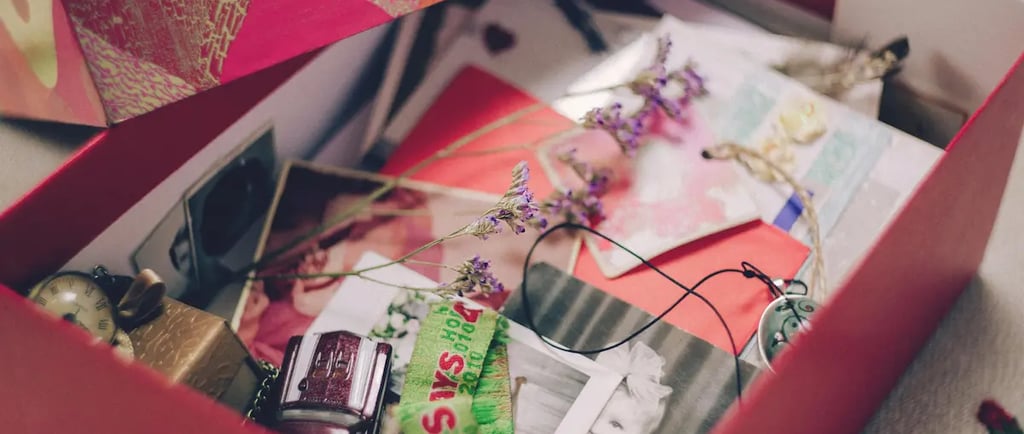
Every day in my work as a Professional Organiser, I encounter clients struggling with sentimental items. That box of your children's artwork, your Grandmother's China, or the concert tickets from your first date, these aren't just objects, they're memories.
Jo de Serrano OBE DUniv
4 min read
Last updated: October 2025
Of all the things I help people sort through, sentimental items are the ones that take the longest. Not because there are usually the most of them, but because every single one comes with a story attached.
The box of your children's artwork. Your grandmother's china. The concert ticket from your first date. A birthday card from someone who is no longer here. These aren't just objects. They are, or at least they feel like, pieces of the people and moments that have shaped you. And that is exactly why letting go of them, even when you want to, is so hard.
I always leave sentimental items until last. Not to avoid them, but because by the time we get to them, you've made hundreds of smaller decisions and your decision-making muscles are properly warmed up. Starting with the emotionally charged stuff is like running a marathon without a warm-up. We don't do that.
The Thing Nobody Tells You About Sentimental Items
Here is what I have come to understand after years of sitting with clients on the floor, surrounded by things that matter: the memory does not live in the object. It lives in you.
That sounds like something you'd find on a motivational poster, and I apologise for that. But I have watched people photograph their grandmother's apron, donate the apron itself, and then frame the photograph in their kitchen, where it sits beautifully and sparks a conversation every single time someone visits. The grandmother is still there. The memory is still there. The apron no longer takes up space in a box nobody opens. There's a whole little economy of people who make things out of your beloved items: teddy bears from baby grows, cushions from nan's curtains.
The object is a container for the memory, but it is not the only container available to you.
What I Actually Do With Clients
The first thing I ask when someone picks up a sentimental item is not "does it spark joy?" With respect to Marie Kondo, that question doesn't work well for grief, complicated relationships or things your children made at age four. Instead, I ask: what does this mean to you, and what would honouring that meaning actually look like?
Sometimes the answer is: I want to keep it. Fine. Keep it. But keep it properly displayed, accessible, intentional, and not buried in a box in the loft where it won't be seen for another decade.
Sometimes the answer is: I feel obligated to keep it, and that's a different thing entirely. Obligation is not love. And the person who gave it to you, in almost every case I have encountered, would not want you to feel burdened by something they intended as a gift.
Sometimes the answer is: I don't actually want this, but letting it go feels like losing the person. That's the one that needs the most time. And that is where we, i.e. you and I, will take the time.
Practical Approaches That Actually Help
Create a digital archive first. Before anything leaves your home, photograph it properly. Not a quick phone snap, but take your time. For children's artwork, there are apps that turn photographs into beautiful printed books. For letters, scan them. For objects, record a short video of yourself talking about what it means to you. The memory is preserved, and the decision becomes easier.
The Legacy Box method. Choose one box, a proper, beautiful box, not a bin bag, for each category of sentimental items. One for your children's things. One for inherited items. One for relationship mementoes, etc. When the box is full, the rule is simple: nothing new comes in unless something else goes out. This keeps sentiment from taking over your entire home.
Display the best, store the rest, release what's left. Pick the single most meaningful item from a collection and display it properly. Frame your grandmother's favourite recipe card. Put one piece of your child's artwork in a proper frame rather than keeping forty pieces in a folder. The ones that don't make the display cut are easier to release once you've honoured the collection with something beautiful.
Ask yourself the right questions. Not "should I keep this?" but: does keeping this serve me now, or am I keeping it for a version of my life that has already passed? Would the person who gave me this want me to feel weighed down by it? Is there someone else for whom this would hold more meaning?
A Word on Guilt
Guilt is the emotion I encounter most in this work. The guilt of letting go of something a parent left you. The guilt of releasing a gift someone saved up for. The guilt of not being the kind of person who keeps everything.
Here is what I know: the love was in the giving, not in the keeping. You are allowed to have a home that works for your present life. You are allowed to let things go. And you do not need to justify that to anyone, including yourself.
If you find yourself stuck with sentimental items and genuinely unable to move forward alone, that is exactly what I am here for. Sometimes you just need someone to sit with you in the middle of it, for as long as it takes.
[Book a free 15-minute discovery call → no obligation, just a chat to find out where you are and what we can do about it.
Order from Chaos
Direct Approach. Bespoke Solutions.
© 2026. All rights reserved.








Based in Croydon, serving London, the Home Counties, and South East England, with virtual services available worldwide. See Areas I Cover
Blog
APDO Member / Enhanced DBS / Fully Insured / ICO Registered: ZB705394
Registered Address: 71-75 Shelton Street, WC2H 9JQ Company Number: 14974139
Order from Chaos is founded by Jo de Serrano OBE DUniv, APDO member, Enhanced DBS cleared, and fully insured. Late-diagnosed AuDHD with 25+ years of professional experience bringing structured, practical thinking to the chaos of everyday home life

