
Wardrobe Organisation in Wimbledon, Warlingham, West Wickham or Wherever
A chaotic wardrobe wastes time every single morning. Jo de Serrano OBE offers practical wardrobe organisation, whether you are in Wimbledon, Warlingham, West Wickham, or wherever. Here is how it works.
Jo de Serrano OBE DUniv
5 min read
Last updated: April 2026
Key Takeaways
More storage is rarely the answer. The wardrobe is usually full of things that do not belong there.
Everything needs to come out before proper decisions can be made. Shuffling things around is not the same thing.
The best system is the one the whole household can actually maintain, not just you on a good day.
Visibility is the difference between wearing something and forgetting you own it.
A single wardrobe typically takes two to three hours. A full bedroom with drawers and storage can run to seven.
A disorganised wardrobe is one of those problems that sounds trivial until you are standing in front of it at seven in the morning, already running late, unable to find the thing you need. It is not trivial. It costs time, energy, and is the kind of low-grade irritation that adds up in ways you stop noticing because it has always been there.
Whether you are in Wimbledon, Warlingham, West Wickham, or somewhere else entirely, here is what I have learned from doing this work, what actually helps, what does not, and what a wardrobe session with Order from Chaos actually involves.
The Problem Is Rarely the Wardrobe Itself
Most people assume they need more storage. A new rail, extra shelves, one of those elaborate systems from a storage shop that promises to solve everything. In my experience, the opposite is almost always true.
The wardrobe is full of things that do not belong there. Clothes that no longer fit, kept just in case. Items held on to out of guilt: the dress that was expensive, the jumper from someone who is no longer here. Seasonal things piled on top of everyday things. The occasional item that has drifted in from another room and never left.
Before we think about organisation, we look at what is actually in the wardrobe. That process almost always creates space that was not visible before. You do not usually need more storage. You need less stuff in the storage you already have.
What a Wardrobe Session Actually Involves
We take everything out and lay it flat so you can see what you have. This may sound alarming, and yes, the bedroom does look significantly worse for about an hour, but it is the only way to make proper decisions rather than just shuffling things around again.
You would be surprised how many of my clients find items of clothing at this point that they have not seen in years. A blouse still in its dry-cleaning bag. A pair of trousers they had forgotten they owned. Things that were buried under other things, which were buried under other things.
From there, we work through what stays and what goes. I do not tell you what to keep. I ask questions that help you decide: Does this fit? Do you reach for it? Does it work with anything else you own? Is it doing anything other than taking up space?
For items with emotional weight- the dress from your sister's wedding, a piece of clothing given to you by someone who has died- we take the time those decisions need. There is no rush. This is not a conveyor belt.
What goes back in is organised in a way that suits how you actually use the space. Visibility matters enormously. If you cannot see it, you will not wear it, and eventually you will forget you own it. Which is how you end up buying a third navy jumper when you already had two perfectly good ones.
The Foundation: Doing It Properly
If you are attempting a wardrobe clear-out yourself, the same principle applies: everything out, clean surfaces, then make decisions. Do not try to declutter a full wardrobe by picking through it whilst it is still full. You will move things from one end to the other and feel like you have done something when you have not.
Be honest about what you actually wear and use. If you have not worn something for a year and cannot think of a specific occasion when you will, that is useful information. If you are keeping something because you are hoping to lose weight, consider whether it will still be what you want to wear, or even still be in fashion, by the time that happens. Weight loss is a perfectly good reason to buy new clothes. It is not a reason to keep a wardrobe full of things that do not fit you now.
Group by category before you put things back: long dresses, trousers, short dresses, skirts, tops, blouses, cardigans, jumpers. Frequently worn items at eye level, seasonal items higher up, less-used things in the harder-to-reach spots.
The Systems That Actually Stick
The most sustainable wardrobe systems share a few things: they are simple enough to maintain without thinking, they account for how the household actually works, and they do not require a good day to use.
That last point matters more than people expect. If it is your other half who most often puts the laundry away, not you, then we need to design a system that they can maintain. There is no point creating something that works for you but falls apart the moment someone else puts a load of washing away.
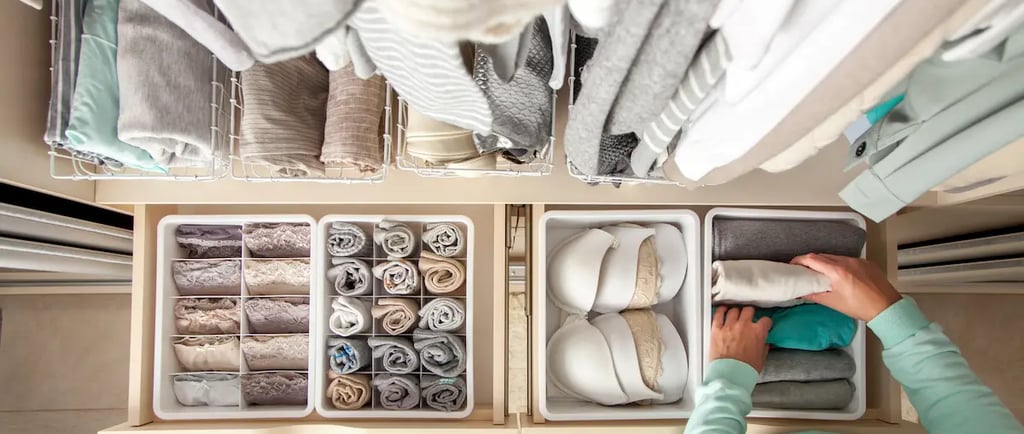
For clients with ADHD or who find decision-making exhausting, which is more common than people realise, particularly during perimenopause, visibility and low-friction access are especially important. A system that requires putting things away carefully every time will not last. If you are not into making neat little parcels of your t-shirts, a normal fold will do. Function first. Aesthetics are a bonus, not the goal.
Invest in slim, non-slip hangers. They make more difference than almost anything else because they give you back horizontal space. Clear storage boxes for seasonal items. Drawer organisers for smaller things. An over-door solution if you are genuinely short of space. None of this needs to be expensive or matching.
Keeping It Going Afterwards
One-in-one-out is the rule that actually works, if you stick to it. Something new comes in; something else goes out. Not when you get around to it. Now, or as close to now as possible.
A donation bag kept somewhere accessible, in the wardrobe itself, or nearby, means things can go straight in as you notice them, rather than sitting in a pile waiting to become a decision again later.
Seasonal reviews, roughly twice a year, stop things drifting back to where they were. Not a full clear-out each time, just a check that the system is still working and that nothing has crept back in that should not be there.
The backward hanger trick is genuinely useful if you want to track what you actually wear: hang everything facing one direction, and when you wear something, hang it back the other way. After three months, anything still facing the original direction has not been worn. That is your evidence.
How Long Does It Take?
A single wardrobe typically takes two to three hours. A full bedroom, wardrobe, drawers, and any additional storage usually runs to around seven hours, sometimes a little more, depending on the volume of decisions involved.
I take donations away at the end of the session, which means there is no pile of bags sitting in the hallway waiting to be dealt with. The session ends with the space finished, not with a new list of things to do.
Not in Wimbledon, Warlingham or West Wickham?
I cover all of London and the Home Counties, so if your wardrobe has been on the to-do list for longer than you care to admit, a discovery call is the easiest first step. It is free, it takes 15 minutes, and you will leave the call with a clear sense of what a session would actually involve for your specific space.
If you would rather start without someone in the room, virtual decluttering sessions are also available. I work alongside you via video call, asking the questions and keeping the momentum going while you make the decisions.
Related Articles
→ The Secret to Staying Organised After a Declutter
→ Is It Worth Selling? A Professional Organiser's Guide
→ Why ADHD Brains Struggle with Clutter, and What Actually Helps
→ Perimenopause and Clutter: Why Your Home Feels Out of Control (And What Helps)
Order from Chaos
Direct Approach. Bespoke Solutions.
© 2026. All rights reserved.








Based in Croydon, serving London, the Home Counties, and South East England, with virtual services available worldwide. See Areas I Cover
Blog
APDO Member / Enhanced DBS / Fully Insured / ICO Registered: ZB705394
Registered Address: 71-75 Shelton Street, WC2H 9JQ Company Number: 14974139
Order from Chaos is founded by Jo de Serrano OBE DUniv, APDO member, Enhanced DBS cleared, and fully insured. Late-diagnosed AuDHD with 25+ years of professional experience bringing structured, practical thinking to the chaos of everyday home life

