Getting the Whole Family on Board with Decluttering
Getting your family to maintain an organised home is less about rules & more about practical systems. A Professional Organiser explains what actually works.
Jo de Serrano OBE DUniv
7 min read
Last updated: May 2026
Key Takeaways
The system has to work for everyone who uses it, including the messiest person in the household and the youngest child.
Children are more capable than most parents expect, at every age, if tasks are appropriate and the system is clear.
Short, frequent sessions work better than marathon declutters for households with young children. Work with nap times and quiet periods, not against them.
Visible, accessible, low-friction storage is the difference between a system children can maintain and one they cannot.
You are trying to build habits, not just tidy a room. The goal is for the system to become automatic, for everyone.
Organising a home with children in it is a different challenge from organising a home without them. The volume of stuff is higher, the rate of re-accumulation is faster, and the people using the systems have not yet developed the habits or the executive function that make maintenance straightforward. Plus, they are usually quite attached to their things.
The goal is not a pristine home. It is a functional one, where things can be found, surfaces can be cleared, and the daily domestic logistics do not eat up more time and energy than they should. That is achievable, with systems designed for real households rather than aspirational ones.
Start With Your Own Expectations
The first thing to get clear on is what "organised enough" looks like for your household. A home with a toddler and a school-age child will not look like a home without children. That is not a failure of organisation; it is a reflection of who lives there and what they need the space for.
Setting the bar at Pinterest-perfect is a reliable route to constant disappointment. Setting it at "I can find things, the main surfaces can be cleared in ten minutes, and the house is ready for unexpected visitors without a full emergency tidy" is much more useful and achievable.
Work in Short Bursts
The days of marathon decluttering sessions are largely over when you have young children. Not because it cannot be done, but because the interruptions, the emotional demands, and the sheer energy required make long sessions difficult to sustain.
Short, focused sessions, fifteen to thirty minutes during nap times, quiet play periods, or after bedtime, are more sustainable and often more productive than longer ones that get derailed halfway through. One drawer. One shelf. One category. That is enough for one session.
Progress compounds. Six fifteen-minute sessions add up to an hour and a half of actual work, without the burnout of a single exhausting day that ends with everything in a pile on the floor
Age-Appropriate Involvement
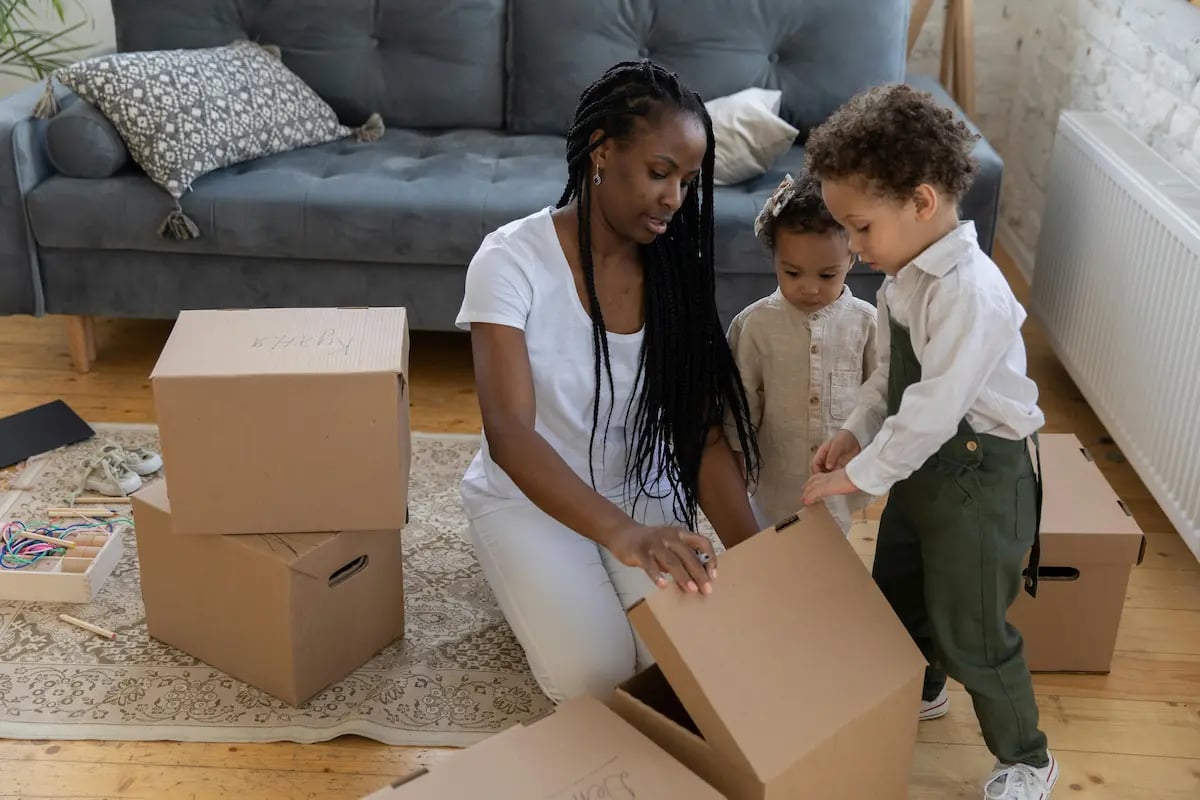
Children can participate in organising and tidying from a much earlier age than most parents realise, as long as the tasks are right for where they are developmentally.
Toddlers (roughly 2–3)
Basic sorting: colours, shapes, big and small. Putting toys into designated bins, especially if the bins are open, visible, and at their height. Tidying can be made into a game or a song at this age and it is worth doing that; you are building a habit, not just clearing a room.
Younger Primary School age (4–7)
Matching items to picture labels on storage. Simple categories with clear visual cues. Following a two or three-step tidying sequence. This is also the age at which a morning checklist starts to work: shoes, bag, coat, done. The visual and physical habits matter more than whether it is perfect.
Older Primary and Secondary (8 and Up)
Creating their own simple organisation systems, with guidance, but not full prescription. Managing their own materials: homework, sports kit, and belongings in their room. Taking real responsibility for a specific household task rather than just helping with yours. Time management basics, including understanding what needs to happen before what.
The general principle: tasks should be just within reach, not comfortable. Children build competence through practice, not through having things done for them.
The Make-It-a-Game Principle for Younger Children
Transformation works better than instruction for young children. "Let's find all the red toys" is more effective than "tidy your toys." "How fast can we get the books back on the shelf?" produces different results from "Put your books away."
This is not about tricking children into tidying. It is about making the activity intrinsically engaging rather than imposed. At three or four, the distinction between a game and a task is largely in how it is framed. Use that.
Reward systems, sticker charts, and small treats for consistent effort can work well at this age if they are kept simple and the rewards are immediate. Long time horizons do not work for young children; the connection between effort and reward needs to be close in time to be meaningful.
Design Systems the Whole Household Can Use
This is the point that gets missed most often, and it matters more than any specific storage product or organisational technique. The system has to work for everyone who uses it, not just you, not just on a good day, not just when everyone is cooperating.
Which means: if your partner is the one who most often puts the laundry away, the laundry system needs to work for them, not just for you. If your child is the one who most often gets their own snacks, the snack storage needs to be at their height and accessible without help. If your family includes someone with ADHD, autism, or executive dysfunction, child or adult, the systems need to account for how their brain actually works, not how you wish it worked.
The practical upshot of this is that you involve the people who will use the system in designing it. Not a full committee meeting; a conversation. "Where would make sense to put this?" "What would make it easier to put that away?" Children, in particular, are often more likely to maintain a system they had some say in than one that was imposed on them.
Storage That Actually Works for Children
The single most useful principle in children's storage: visible, accessible, and low-friction. If a child cannot see it, they will not know it exists. If they cannot reach it, they will not use it. If putting it away requires more than one step, it will not get put away.
Open baskets and bins rather than lidded boxes. Clear containers where you want children to be able to identify what is inside. Labels with pictures for pre-readers, and with words alongside once they are reading, so the picture label does not become a crutch. Low hooks for bags and coats, placed where the child actually comes in rather than where it would look tidiest.
Limit the volume of toys in rotation at any one time. Not forever, just in circulation. When there is less available, it is easier to tidy, easier to find things, and ironically, children tend to play more purposefully with a smaller selection. The rest can be stored and rotated in.
The One-In-One-Out Rule With Children
Implementing one-in-one-out before a birthday or Christmas is considerably more effective than trying to do it afterwards, when the child has already formed an attachment to all the new things. The conversation before the event, "when the new things come, we'll choose some things to pass on to children who would like them", lands differently from "now we need to get rid of some of your stuff to make room."
Framing donation as something positive rather than a loss helps too. Choosing which toys to pass on to a specific younger child, or to a charity that will give them to a child who does not have much, is a different emotional experience from just getting rid of things.
Building Routines That Stick
Three tidy points in a day work well for most households with children: a morning reset before school or the day starts; a short afternoon reset after activities; and an evening tidy before bed. None of these needs to be long. Ten minutes consistently beats an hour once a week.
The evening tidy, in particular, has a disproportionate effect on the next morning. A morning that starts in a cleared space is less pressured and less likely to result in lost items, missed things, and the particular misery of the school-run hunt for something that should have been in a known place.
Routines need to be specific enough to be actionable. "Tidy your room" is not specific enough. "Put your clothes in the laundry, books on the shelf, and toys in the baskets" is. Checklists help, particularly for children who find the sequence of tasks hard to hold in their heads without support.
When the Family Does Not Cooperate
I'm not going to pretend this is not a real problem, because it is. You can design the perfect system and still find that other members of the household do not use it, or use it inconsistently, or actively undermine it.
A few things that help. First: make it easier to do the right thing than the wrong thing. If putting something away requires the same effort as leaving it out, some people will put it away; others will not. If putting it away is easier because the designated spot is obvious, accessible, and close to where the item is used, the compliance rate goes up significantly.
Second: pick your battles. Maintaining consistent standards across every area of a family home is exhausting and often counterproductive. Some areas matter more than others. The kitchen, the hallway, the main shared spaces- these are worth protecting. A teenager's bedroom that is comprehensively chaotic is not your problem to solve.
Third: involve people in the consequences of the system not working, rather than in abstract arguments about tidiness. "When things are not in their places, I spend twenty minutes looking for them every morning, and I am stressed before the day starts" is a more productive conversation than "you never put anything away."
Remember that small wins lead to lasting changes. And if you need help, book a discovery call today or check out our services page.
Related Articles
→ The Secret to Staying Organised After a Declutter
→ Managing Adult Children's Belongings: A Practical Guide
→ Why ADHD Brains Struggle with Clutter, and What Actually Helps
Order from Chaos
Direct Approach. Bespoke Solutions.
© 2026. All rights reserved.








Based in Croydon, serving London, the Home Counties, and South East England, with virtual services available worldwide. See Areas I Cover
Blog
APDO Member / Enhanced DBS / Fully Insured / ICO Registered: ZB705394
Registered Address: 71-75 Shelton Street, WC2H 9JQ Company Number: 14974139
Order from Chaos is founded by Jo de Serrano OBE DUniv, APDO member, Enhanced DBS cleared, and fully insured. Late-diagnosed AuDHD with 25+ years of professional experience bringing structured, practical thinking to the chaos of everyday home life

